Additional Information
This page collects supporting material that does not belong only to diversity indices, dissimilarity indices, the framework, or the API reference.
Choosing Shannon Estimators
Shannon entropy estimation is sensitive to finite sample size, unseen support, and whether the category universe is known. The package uses estimator objects so the choice is visible in the call.
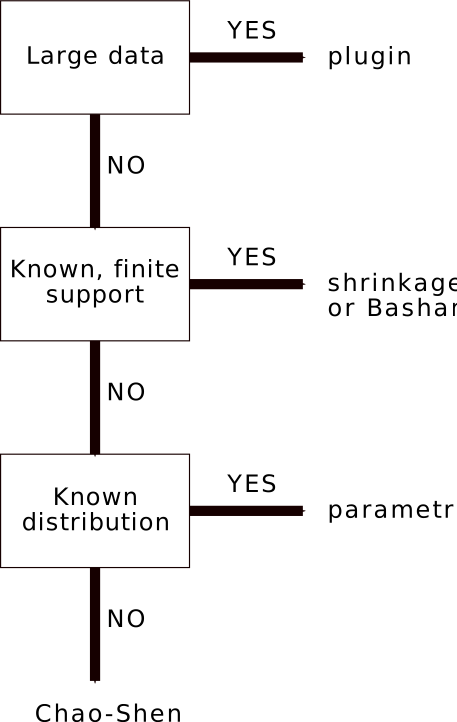
A practical starting point:
- Use
Pluginwhen sample size and coverage are high. - Compare
MillerMadowwhen an observed-support first-order bias correction is appropriate. - Use
HausserStrimmer,Basharin, orAddGammawhen the finite support is known. - Use
ChaoShenwhen support is unknown and unseen categories are plausible.
julia> using DiversityAndDissimilarity

julia> assemblage = Dict(:oak => 12, :ash => 5, :elm => 3);

julia> entropy(Shannon(; estimator=Plugin()), assemblage)
1.3527241956246545

julia> entropy(Shannon(; estimator=MillerMadow()), assemblage)
1.4248589476691027

julia> entropy(Shannon(; estimator=AddGamma(1)), assemblage; support=5)
1.7792365361682794
Use estimator_report to compare estimators and coverage diagnostics on one assemblage:
julia> report = estimator_report([1, 1, 2, 0, 5]);

julia> report.observed_richness
4

julia> report.sample_coverage
0.7777777777777778
Reference Values
Reference examples are part of the test suite. They pin conventions to simple published or cross-package values.
julia> x = [1, 1, 2];

julia> entropy(Shannon(; base=ℯ), x)
1.0397207708399179

julia> gini_simpson_index(x)
0.625

julia> inverse_simpson_index(x)
2.6666666666666665
For pairwise comparisons:
julia> bray_curtis_distance([1, 2, 3], [2, 2, 0])
0.4

julia> jaccard_similarity([1, 1, 0, 1], [1, 0, 1, 1])
0.5
The public validation API exposes a small reference corpus:
julia> results = validate_reference_cases();

julia> all(r -> r.passed, results)
true

julia> first(results).name
"vegan_shannon_natural_log"
The validation directory also records candidate external datasets such as the scikit-bio tutorial matrix, vegan's dune, varespec, BCI, and mite, and iNEXT's spider data.
Scaling Notes
Most single-assemblage calculations are linear in the number of inspected categories. The most important scaling variables are:
S: observed support, the number of positive taxa/categories;K: known finite support supplied throughsupport;M: number of samples/sites, usually rows in a community matrix;P: number of taxa/categories columns;B: number of bootstrap replicates.
Rules of thumb:
- alpha-diversity on one abundance vector is usually
O(S)orO(P); - row-wise alpha diversity on a dense community matrix is
O(MP); - pairwise community matrices are usually
O(M^2 P)time andO(M^2)memory; - finite-support estimators can scale with
K, not only observedS; - bootstrap cost grows roughly linearly with
nboot.
For large pairwise workflows, prefer bounded measures with interpretable ranges when that suits the scientific question:
julia> is_bounded(BrayCurtis())
true

julia> is_bounded(KullbackLeibler())
false
Translating Common vegan Calls
Both vegan and this package commonly use community matrices with samples in rows and species in columns. Important convention differences:
| vegan | DiversityAndDissimilarity.jl | Notes |
|---|---|---|
specnumber(x) | richness(x) | Observed positive-abundance taxa. |
diversity(x, "shannon") | entropy(Shannon(; base=ℯ), x) | vegan defaults to natural logs; this package defaults to bits. |
diversity(x, "simpson") | gini_simpson_index(x) | vegan's Simpson output is 1 - sum(p_i^2). |
diversity(x, "invsimpson") | inverse_simpson_index(x) | Inverse Simpson diversity. |
estimateR(x) | chao1(x) / ace(x) | Richness estimators. |
vegdist(x, method="bray") | bray_curtis_distance(x) | Bray-Curtis dissimilarity. |
vegdist(x, method="jaccard", binary=TRUE) | jaccard_distance(x) | Presence/absence Jaccard. |
vegdist(decostand(x, "hellinger"), method="euclidean") | hellinger_distance(x) | Hellinger distance. |
Broader ordination, constrained analysis, rarefaction curves, and ecological modelling remain vegan strengths. This package focuses on lightweight, convention-aware calculations.
Generated Documentation Assets
The type tree is generated from exported package types:
julia --project=docs docs/make_type_trees.jlThis writes:
docs/src/assets/type-tree.dotdocs/src/assets/type-tree.svgdocs/src/assets/type-tree.pdf
Graphviz's dot command is required for SVG and PDF rendering. The DOT file is still written if Graphviz is unavailable.
Local Documentation Build
Build the manual from the repository root:
julia --project=docs -e 'using Pkg; Pkg.develop(PackageSpec(path=pwd())); Pkg.instantiate(); include("docs/make.jl")'The documentation uses doctests for many examples, so examples on these pages are checked as part of the build.