SymbolicLongMemorySequences.jl
Self-Similar Symbols Sequence Synthesis
SymbolicLongMemorySequences.jl generates Long-Range Dependent (LRD) sequences of categorical (non-numerical) symbols. It produces controllable synthetic data for LRD estimator tests, information-theoretic experiments, and LLM-style neural sequence models trained on challenging non-language symbolic streams.
Quick start
using SymbolicLongMemorySequences, StableRNGs

rng = StableRNG(42)

alphabet = [:a, :b, :c]
g = make_generator(:PB1, alphabet; H = 0.8, marginal = [0.2, 0.3, 0.5])
seq = generate(g, 10_000; rng)

method_ids()
method_info(:PB1).defaults
method_parameters(:PB1)
empirical_marginal(seq, alphabet)

# Save to INC format with full provenance metadata
save_sequence("seq_pb1.inc", seq, g)
Use make_generator(id, alphabet; kwargs...) for standard cases. The id may be a method identifier such as :PB1, a string such as "MB1c", or an exported type-name alias such as :SpectralFGN. Use method_ids() to list methods and method_info(id) to inspect defaults, standard cases, and a short description. Use method_parameters(id) to inspect accepted factory keywords, default values, domains, and short descriptions. The method-specific constructors remain the precise API when you need full control over transition matrices, excitation matrices, or other scientific settings. See API for the clean construction and testing workflow.
Property-based methods also have a composable pathway:
source = SpectralFGNSource(0.8)
symbolizer = QuantileSymbolizer(alphabet, [0.2, 0.3, 0.5])
g = PropertyBasedGenerator(source, symbolizer)
This separates the numerical LRD source from the symbolic transformation. PB1, PB2, PB3, and PB4 are the standard combinations; the composable API is useful when validating how a different symbolization changes the inherited latent long-memory behavior.
The full model taxonomy is:
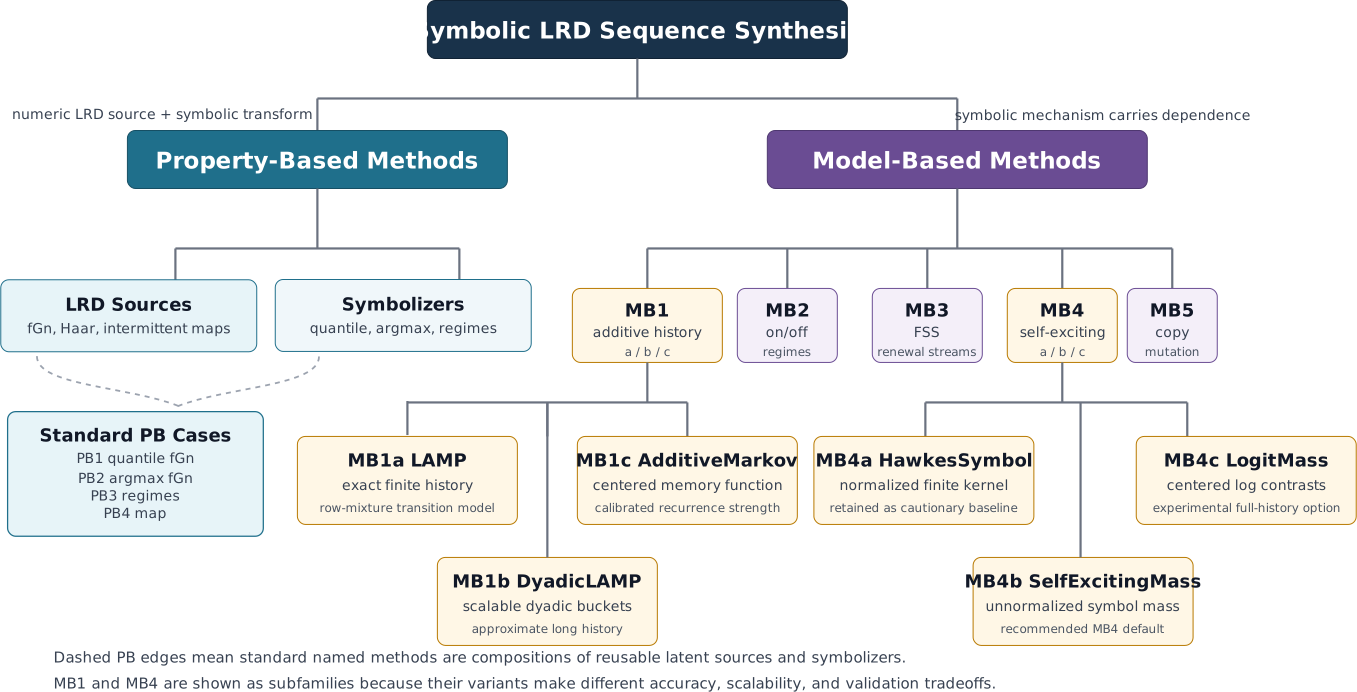
MB1 and MB4 are subfamilies rather than single algorithms. MB1 contains exact, dyadic, and centered additive-history variants. MB4 contains the original normalized Hawkes-style process plus two unnormalized self-exciting mass variants.
Generators
| ID | Type | LRD mechanism | Short-range control | Complexity |
|---|---|---|---|---|
| PB1 | SpectralFGN | Spectral $1/f^\alpha$ shaping | Poor (set by quantization) | $O(n \log n)$ |
| PB2 | LGCM | Latent fGn streams + argmax | Offset-calibrated marginals | $O(n \cdot k \cdot I)$ |
| PB3 | WaveletMarkov | Spectral or Haar latent driver + Markov regimes | Per-regime Markov matrices | $O(n \log n + n \cdot k)$ |
| PB4 | IntermittentMapSymbols | Intermittent-map latent driver | Poor (set by quantization) | $O(n \log n)$ |
| MB1a | LAMP | Exact power-law history weights | History-weighted transition matrix | $O(n \cdot \min(d,n))$ |
| MB1b | DyadicLAMP | Dyadic approximation to power-law history | History-weighted transition matrix | $O(n k \log n \log \min(d,n))$ |
| MB1c | CalibratedAdditiveMarkov | Centered additive memory function | Symbol recurrence through additive memory | $O(n \cdot \min(d,n))$ |
| MB2 | OnOffMarkov | Heavy-tailed regime sojourns | Per-regime Markov matrices | $O(n \cdot k)$ |
| MB3 | FSS | Pareto renewal process per symbol | Poor (independent streams) | $O(n \cdot k)$ |
| MB4a | HawkesSymbol | Normalized power-law self/cross-excitation | Excitation matrix | $O(n \cdot k \cdot \min(d,n))$ |
| MB4b | SelfExcitingMass | Unnormalized self-exciting symbol mass | Target marginal plus excitation matrix | $O(n \cdot k \cdot \min(d,n))$ |
| MB4c | LogitSelfExcitingMass | Centered log-contrast self-exciting mass | Target marginal plus excitation matrix | $O(n \cdot k \cdot \min(d,n))$ or $O(n^2k)$ |
| MB5 | DuplicationMutation | Power-law lag copy/mutate growth | Growth-induced copy structure | $O(n \log d + d)$ |
LRD parameters
Each generator exposes either a direct Hurst parameter $H \in (1/2, 1)$ or a tail/decay parameter with a nominal relationship to $H$:
| Type | Input parameter | Relationship to $H$ |
|---|---|---|
SpectralFGN | H | direct |
LGCM | H | direct |
WaveletMarkov | H | latent-driver target |
IntermittentMapSymbols | z | latent intermittency strength |
LAMP | beta ($\beta$) | $H = (2 - \beta) / 2$ |
DyadicLAMP | beta ($\beta$) | finite dyadic approximation to $H = (2 - \beta) / 2$ |
CalibratedAdditiveMarkov | beta ($\beta$) | finite additive memory-function decay |
OnOffMarkov | alpha ($\alpha$) | nominal $H = (3 - \alpha) / 2$ |
FSS | alpha ($\alpha$) | $H = (3 - \alpha) / 2$ |
HawkesSymbol | beta ($\beta$) | normalized finite power-law excitation kernel |
SelfExcitingMass | beta ($\beta$) | unnormalized finite power-law excitation mass |
LogitSelfExcitingMass | beta ($\beta$) | unnormalized power-law mass converted to centered log contrasts; d = nothing uses full available history |
DuplicationMutation | alpha ($\alpha$) | copy-distance exponent; validation uses alpha - 1 as an empirical reference slope |
Controllability
All implemented generators accept an explicit ordered alphabet. Duplicate alphabet entries are rejected because they make empirical frequency tables ambiguous.
Use control_capabilities(g) to inspect the strength and scope of the controls a generator claims. It distinguishes direct finite-sample or empirical controls from implied, asymptotic, induced, latent, and nominal behavior.
| Type | Marginal control | Local structure control |
|---|---|---|
SpectralFGN | direct marginal; rank binning gives integer counts as close as possible to target | none |
LGCM | direct marginal; calibrated latent offsets | none |
WaveletMarkov | aggregate stationary marginal implied by regimes | per-regime bigram matrices |
IntermittentMapSymbols | direct marginal; rank binning gives integer counts as close as possible to target | none |
LAMP | direct marginal mixed through epsilon; larger epsilon improves marginal control | exact history-weighted transition matrix |
DyadicLAMP | direct marginal mixed through epsilon; larger epsilon improves marginal control | dyadic-bucket approximation to history-weighted transition matrix |
CalibratedAdditiveMarkov | centered additive memory around marginal; strength = 0 is iid | additive memory induces recurrence |
OnOffMarkov | aggregate stationary marginal implied by regimes | per-regime bigram matrices |
FSS | asymptotic rates / sum(rates) | none |
HawkesSymbol | baseline distribution reported, output marginal implied by excitation | normalized excitation matrix |
SelfExcitingMass | default marginal target, finite sample shaped by excitation | unnormalized excitation mass |
LogitSelfExcitingMass | default marginal target, finite sample shaped by contrast strength | centered log excitation contrasts |
DuplicationMutation | seed/mutation replacement distribution; output marginal shaped by copied history | copy/mutate growth-induced |
First-order local structure can be represented by a validated MarkovSpec:
spec = MarkovSpec([:a, :b], [0.9 0.1; 0.2 0.8])
g1 = WaveletMarkov(0.8, [spec, spec])
g2 = OnOffMarkov(1.5, [spec, spec], [0.2 0.8; 0.8 0.2])

control_capabilities(g1).bigram
WaveletMarkov and OnOffMarkov provide :per_regime bigram control. Their aggregate observed bigrams depend on regime differences and switching behavior. If all regimes use the same MarkovSpec, that common transition matrix is also the unambiguous aggregate target.
MarkovSpec is the current concrete LocalStructureSpec, and local_structure_order(spec) returns its order. This is the intended extension point for future sparse higher-order controls. SymbolicLongMemorySequences.jl currently provides empirical_trigram for diagnostics, but it does not expose a trigram-control specification.
For WaveletMarkov and OnOffMarkov, one-hot symbol diagnostics need regimes with different stationary symbol distributions. If each regime has the same stationary marginal, the latent regime process can be long-memory while the symbol-level ACF and spectrum look nearly short-memory. WaveletMarkov defaults to driver = :spectral, which rank-bins an approximate spectral fGn latent series into regimes. The legacy driver = :haar cascade is retained for comparison in validation studies.
Reproducible controllability studies and performance runs are documented on Validation and Benchmarks.
Motivations
SymbolicLongMemorySequences.jl is intended for several related research uses:
- testing NN-LRD estimators on sequences with known generator settings;
- probing excess entropy rate, entropy-rate convergence, and other information-theoretic summaries of long-memory symbolic data;
- creating non-language but language-like long-context sequences for training and stress-testing LLM-style neural networks;
- separating local bigram/trigram competence from genuine long-context modelling;
- studying anomaly detection, change detection, and synthetic privacy-preserving categorical data with realistic burstiness.
INC output format
All generated sequences should be saved with save_sequence, which writes the data and full provenance metadata (package version, generator type and parameters, creation date) in the INC format.
save_sequence("output.inc", seq, g)The resulting file has this structure:
---
title = SymbolicLongMemorySequences.jl synthetic LRD symbol sequence
package = SymbolicLongMemorySequences
version = "0.1.0"
generator = SpectralFGN
method = PB1
n = 10000
created = "2026-06-04"
[generator_params]
H = "0.8"
alphabet_size = 3
alphabet = "a,b,c"
marginal = "0.33333333,0.33333333,0.33333334"
[columns]
index = time index (1-based)
symbol = generated symbol from the alphabet
---
index,symbol
1,b
2,a
…
Background
Long-Range Dependence (LRD) means that the large-scale statistical structure of a sequence is as important as its short-range structure. Formally, a sequence is LRD if its autocovariance function (ACF) decays as a power law:
\[\gamma_k \sim c_\gamma |k|^{-\beta}, \quad \beta \in (0, 1),\]
with Hurst parameter $H = (2-\beta)/2 \in (1/2, 1)$.
LRD is ubiquitous in human-generated data (natural language, Internet traffic, genomics, social media), yet almost all LRD synthesis tools target numerical data. SymbolicLongMemorySequences.jl fills that gap for symbol sequences — data taking values in a finite, unordered alphabet.
References
- Paxson, V. (1997). Fast, approximate synthesis of fractional Gaussian noise. CCR 27.
- Li, W. (1991). Expansion-modification systems: a model for spatial 1/f spectra. Physical Review A 43.
- Li, W., Marr, T. G., & Kaneko, K. (1994). Understanding long-range correlations in DNA sequences. Physica D 75.
- Melnyk, S. S., Usatenko, O. V., & Yampol'skii, V. A. (2006). Memory functions of the additive Markov chains. Physica A 361.
- Mayzelis, Z. A., Apostolov, S. S., Melnyk, S. S., Usatenko, O. V., & Yampol'skii, V. A. (2006). Additive N-step Markov chains as prototype model of symbolic stochastic dynamical systems with long-range correlations.
- Kumar, R., Raghu, M., Sarlós, T., & Tomkins, A. (2017). Linear additive Markov processes. WWW '17.
- Lowen, S. B. & Teich, M. C. (1995). Fractal stochastic point processes. Fractals 3(1).
- Provata, A., & Beck, C. (2012). Coupled intermittent maps modelling the statistics of genomic sequences: a network approach. arXiv:1205.2249.
- Pipiras, V. & Taqqu, M. S. (2017). Long-Range Dependence and Self-Similarity. Cambridge UP.