API
SymbolicLongMemorySequences.jl has two public construction paths:
- use
make_generatorfor standard, named cases across all implemented methods; - compose a
LatentSourcewith aSymbolizerfor property-based studies that need to vary the numerical driver and the symbolization rule separately; - use the method-specific constructors when a study needs full control of the scientific parameters.
Both paths return an LRDGenerator and both use the same generation call:
seq = generate(g, n; rng)Always pass an explicit rng when a sequence needs to be reproducible.
Property-based generators also support an additive validation helper:
seq, latent = generate_with_latent(g, n; rng)latent is a width × n numerical matrix containing the LRD driver before symbolization. Use this when a study needs to diagnose the numerical source and the symbolic transform separately.
Standard Method Factory
The factory is the cleanest way to list methods, inspect their standard parameters, and build a generator for examples, smoke tests, and benchmark grids.
using SymbolicLongMemorySequences, StableRNGs

alphabet = [:a, :b, :c]
g = make_generator(:PB1, alphabet; H = 0.8, marginal = [0.2, 0.3, 0.5])
seq = generate(g, 8; rng = StableRNG(42))
Example output:
8-element Vector{Symbol}:
 :a
 :c
 :b
 :c
 :c
 :a
 :c
 :b
id may be a stable method identifier, a string, or an exported type-name alias:
make_generator(:PB1, alphabet)
make_generator("MB1c", alphabet)
make_generator(:SpectralFGN, alphabet)
Use method_ids and method_info to discover supported methods:
method_ids()
method_ids(family = :model_based)
method_info(:MB5).defaults
method_parameters(:MB5)
method_info(:SpectralFGN).id
The entries returned by method_parameters(id) describe the factory keywords accepted by that method:
[(p.name, p.default, p.domain) for p in method_parameters(:PB1)]Example output:
2-element Vector{Tuple{Symbol, Any, String}}:
 (:H, 0.8, "0.5 < H < 1")
 (:marginal, :uniform, "`:uniform` or a probability vector with one entry per symbol")
All factory methods also require the positional alphabet input. The generated sequence length n is supplied later through generate(g, n; rng).
Factory defaults are standard examples, not finite-sample scientific calibrations. For validation studies that support method-specific claims, prefer explicit constructors so the parameter assumptions remain visible in the script.
Method IDs
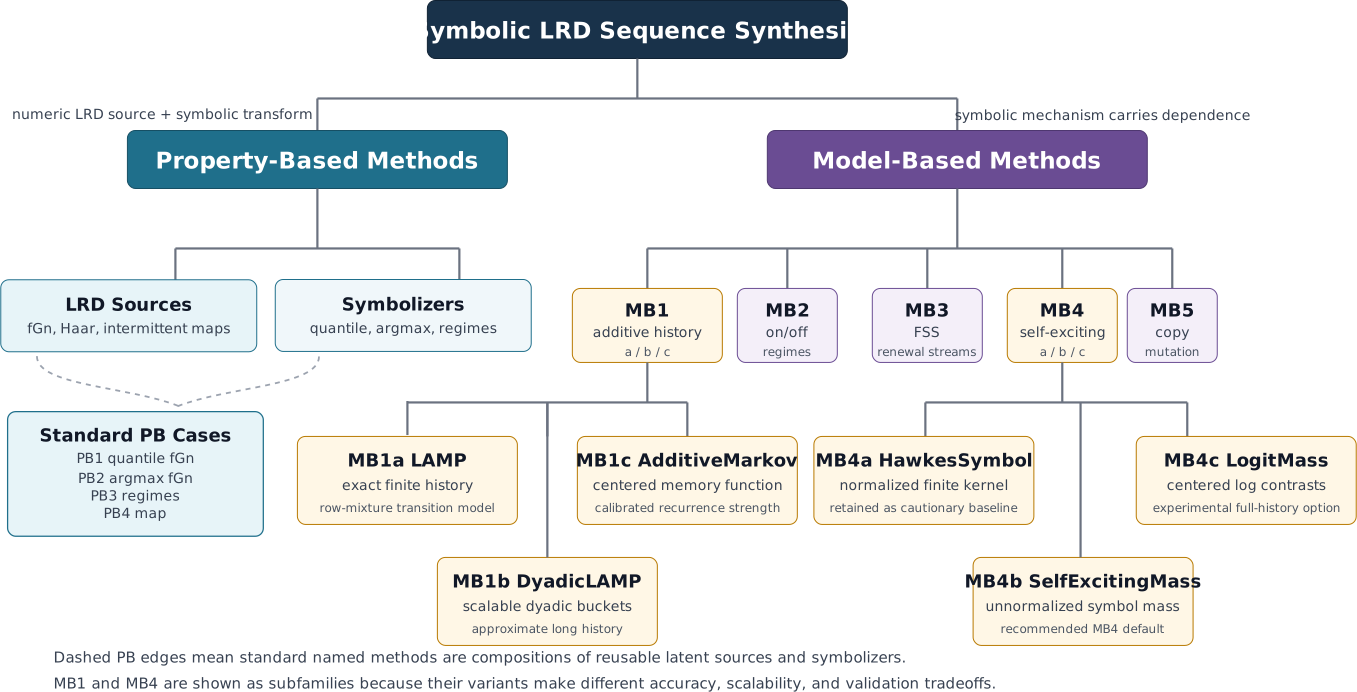
The stable method IDs follow the taxonomy above. :MB4 is kept as a convenient alias for the recommended MB4b SelfExcitingMass standard case; use :MB4a or :MB4c when the normalized Hawkes baseline or logit-contrast variant is needed explicitly.
| ID | Type | Standard cases |
|---|---|---|
:PB1 | SpectralFGN | :standard |
:PB2 | LGCM | :standard |
:PB3 | WaveletMarkov | :persistent_regimes, :iid_regimes |
:PB4 | IntermittentMapSymbols | :standard |
:MB1a | LAMP | :repeat, :iid |
:MB1b | DyadicLAMP | :repeat, :iid |
:MB1c | CalibratedAdditiveMarkov | :standard, :iid |
:MB2 | OnOffMarkov | :persistent_regimes, :iid_regimes |
:MB3 | FSS | :standard |
:MB4 | SelfExcitingMass | :identity_excitation |
:MB4a | HawkesSymbol | :identity_excitation |
:MB4b | SelfExcitingMass | :identity_excitation |
:MB4c | LogitSelfExcitingMass | :identity_excitation |
:MB5 | DuplicationMutation | :standard |
Common keywords are shared where they mean the same thing:
marginal = :uniformsets or approximates a target marginal when a method has a meaningful marginal-control knob;caseselects one of the standard cases listed above;H,beta,alpha, orzselect the method's nominal LRD-related parameter;dsets an explicit finite history cutoff for history-based methods.
Composable Property-Based API
Property-based generators can be described as:
PropertyBasedGenerator(source, symbolizer)The source creates one or more numerical latent LRD series. The symbolizer turns those latent values into categorical symbols. This split makes the PB taxonomy explicit: PB1, PB2, PB3, and PB4 are standard combinations rather than unrelated mechanisms.
using SymbolicLongMemorySequences, StableRNGs

source = SpectralFGNSource(0.8)
symbolizer = QuantileSymbolizer([:a, :b, :c], [0.2, 0.3, 0.5])
g = PropertyBasedGenerator(source, symbolizer)

generate(g, 8; rng = StableRNG(42))
Example output:
8-element Vector{Symbol}:
 :a
 :c
 :b
 :c
 :c
 :a
 :c
 :b
Available latent sources are:
| Source | Latent behavior | Width |
|---|---|---|
SpectralFGNSource(H) | approximate spectral fGn | any positive width |
HaarLRDSource(H) | Haar-like multiscale driver | any positive width |
IntermittentMapSource(z) | intermittent-map dynamics | one stream |
Available symbolizers are:
| Symbolizer | Transformation | Required width |
|---|---|---|
QuantileSymbolizer | rank-bin one latent stream to target counts | 1 |
ArgmaxSymbolizer | choose the largest offset latent stream | alphabet size |
MarkovRegimeSymbolizer | rank-bin one latent stream to Markov regimes | 1 |
Some combinations are intentionally invalid. For example, IntermittentMapSource cannot feed ArgmaxSymbolizer, because the intermittent map source currently produces only one latent stream and argmax symbolization needs one stream per symbol.
PB3's regime construction can also be built directly:
P1 = [0.95 0.05; 0.10 0.90]
P2 = [0.30 0.70; 0.70 0.30]
source = HaarLRDSource(0.8)
symbolizer = MarkovRegimeSymbolizer([:a, :b], [P1, P2])
g = PropertyBasedGenerator(source, symbolizer)
Use the composable API when the study is about transformations. Use make_generator when the study only needs a standard named method.
To inspect the numerical driver used by a property-based generator:
seq, latent = generate_with_latent(g, 8; rng = StableRNG(42))
size(latent)
Example output:
(1, 8)Explicit Constructors
Use explicit constructors when a model needs exact transition matrices, excitation matrices, rates, or calibration parameters.
using SymbolicLongMemorySequences, StableRNGs

P1 = [0.9 0.1; 0.2 0.8]
P2 = [0.3 0.7; 0.6 0.4]
Q = [0.2 0.8; 0.8 0.2]

g = OnOffMarkov(1.5, [:a, :b], [P1, P2], Q; L_min = 50.0)
generate(g, 6; rng = StableRNG(7))
Example output:
6-element Vector{Symbol}:
 :a
 :b
 :b
 :b
 :b
 :b
The constructors validate alphabets, probability vectors, transition matrices, rates, and parameter ranges at construction time. Invalid construction should raise ArgumentError.
Controls
Every generator accepts an ordered alphabet and emits only values from that alphabet. Duplicate alphabet entries are rejected because they make empirical frequency tables ambiguous.
Use control_capabilities to ask what a generator claims to control:
g = make_generator(:MB1c, [:a, :b]; beta = 0.5, d = 500)
control_capabilities(g).marginal
Example output:
:centeredUse the empirical helpers for short, transparent diagnostics:
seq = [:a, :b, :a, :a]
empirical_marginal(seq, [:a, :b])
Example output:
2-element Vector{Float64}:
 0.75
 0.25
First-order local structure is represented by MarkovSpec:
spec = MarkovSpec([:a, :b], [0.9 0.1; 0.2 0.8])
local_structure_order(spec)
Example output:
1MarkovSpec is currently used by WaveletMarkov and OnOffMarkov. The abstract LocalStructureSpec is the extension point for a future trigram or higher-order specification, but SymbolicLongMemorySequences.jl does not yet expose trigram control.
Output And Provenance
Use save_sequence to write generated data with provenance metadata in INC format:
g = make_generator(:PB1, [:a, :b]; H = 0.75)
seq = generate(g, 100; rng = StableRNG(11))
save_sequence("seq_pb1.inc", seq, g)
The file records the generator type, method identifier, sequence length, creation date, and generator parameters. Retained validation outputs should use the same provenance discipline.
Tests
The main test path checks the public contracts:
julia --project=. -e 'using Pkg; Pkg.test()'The fast tests cover construction errors, output length and element type, alphabet membership, reproducible RNG use, provenance metadata, factory discovery, and small bounded checks for declared controls. Broader empirical studies belong on the Validation and Benchmarks page rather than in the fast package test suite.